
Independent workers work alone. Their notes don't have to.
An agency worker has a team leader checking their notes. An independent worker has no one. Clio Care is the support around them: notes linked to your participant's goals, gaps flagged before they sign, and goal progress reports built from the facts.
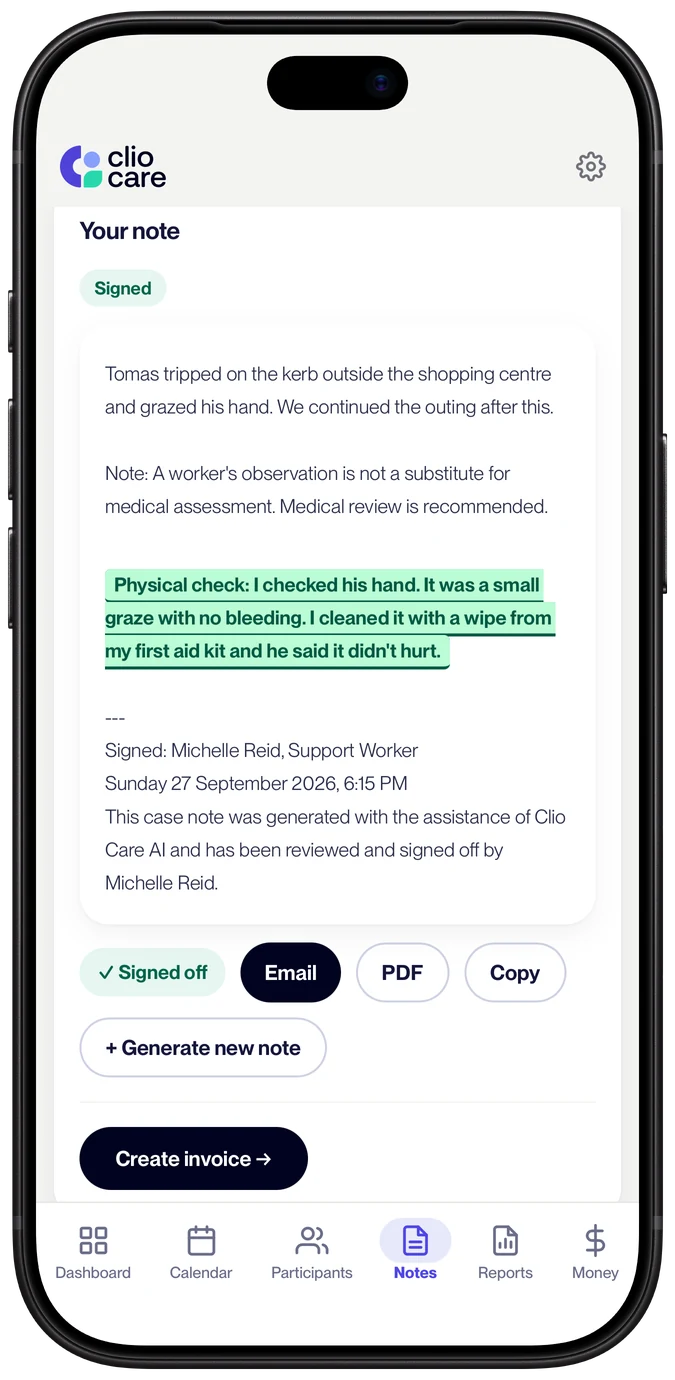
Your report is only as good as the notes behind it.
You owe the NDIA an implementation report 8 weeks into a plan, more along the way, and a plan reassessment and evaluation report before the next plan. Each one needs evidence of how the participant is going against their goals, and a lot of that evidence sits with their support workers.
Agency workers have training, a team leader reading their notes and an office chasing the details. Independent workers do it all on their own, after the shift, often in the car. Some notes are thorough. Some say "good day, went to the shops". Few say which goal the shift was for. So you chase, then rewrite.
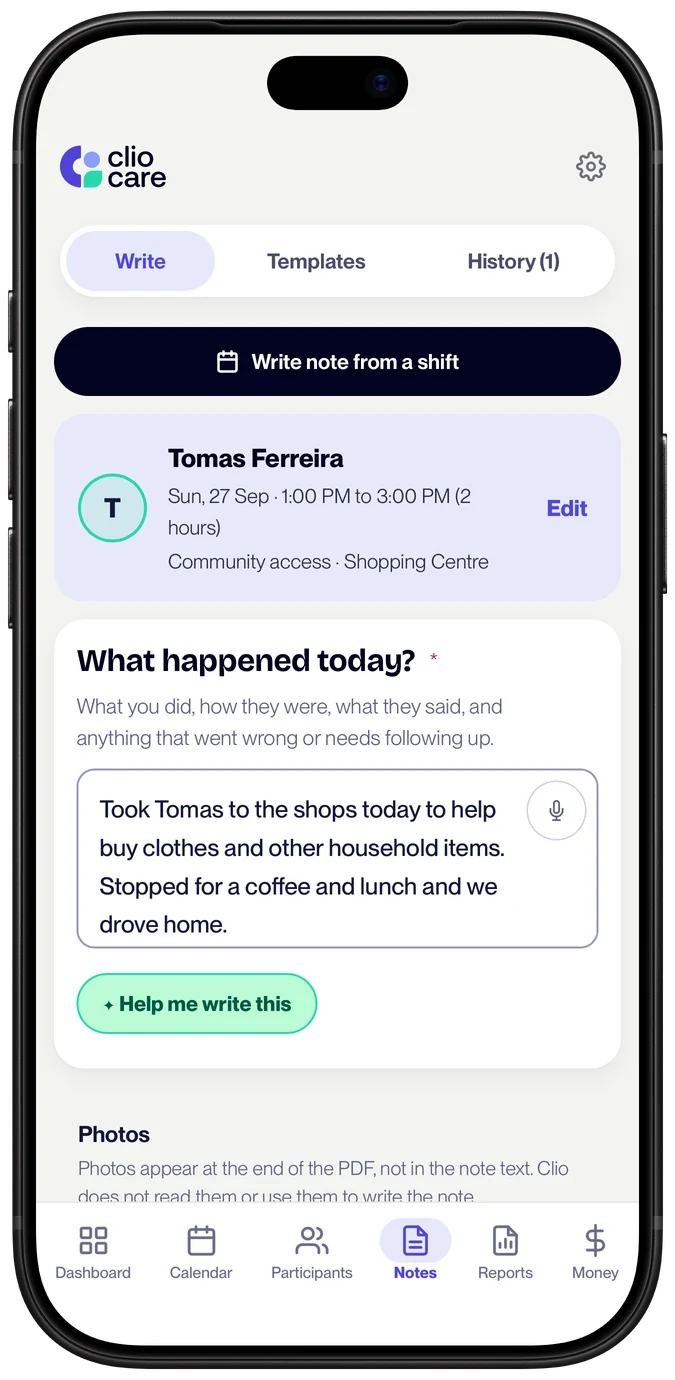
The help a team leader would give, before they write.
Guidance on every shift. The worker talks or types what happened, the way they'd tell a colleague. Clio Care turns it into a clear NDIS case note, and helps them get it right from the start.
- Help before they start. Clio Care suggests what's worth including, based on the participant's plan and goals.
- Their own words, nothing added. Clio Care only writes what the worker described. It never invents activities, quotes or progress.
- Linked to the participant's goals. Each note is tied to the goals in the participant's NDIS plan when the shift relates to them, so progress builds up shift by shift.
- Written as the worker. Notes are in the first person, because the worker is the author.
- Feedback on their writing. After every note, Smart Tips gives the worker three short tips, like a mentor would: something they did well first, then anything that would make the next note stronger.
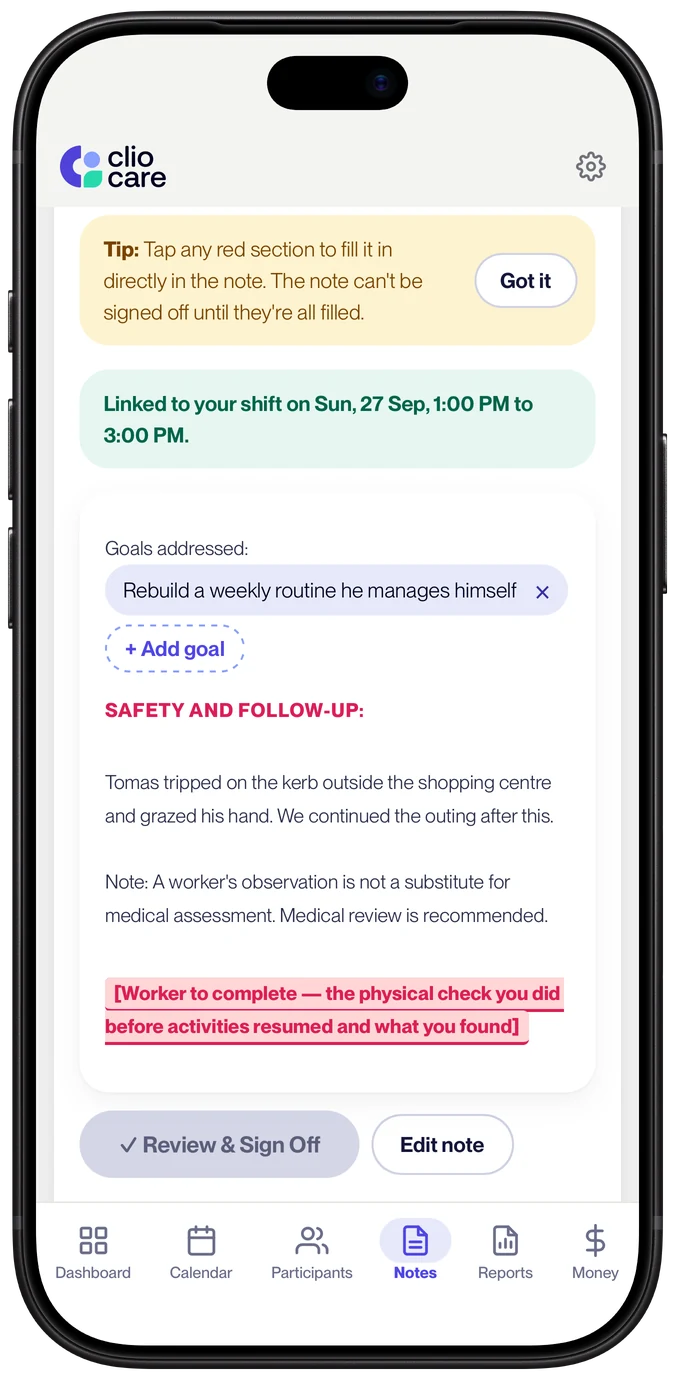
A second pair of eyes, before they sign.
Gaps pointed out, not filled in. If a note needs something the worker didn't mention, like the check they did after a fall, Clio Care marks the spot in red instead of guessing. The note can't be signed until it's filled in.
- Checked before signing. Clio Care reviews each note and shows anything that needs a second look before the worker's name goes on it.
- Incidents flagged on the day. If what a worker describes could be a reportable incident, Clio Care flags it and names the category, so it's recorded while it's fresh.
- Signed by the worker. Every note is read, edited if needed and signed off by the worker.
- The original kept. Clio Care keeps its first version beside the signed one, so any note can be checked against what the worker changed.
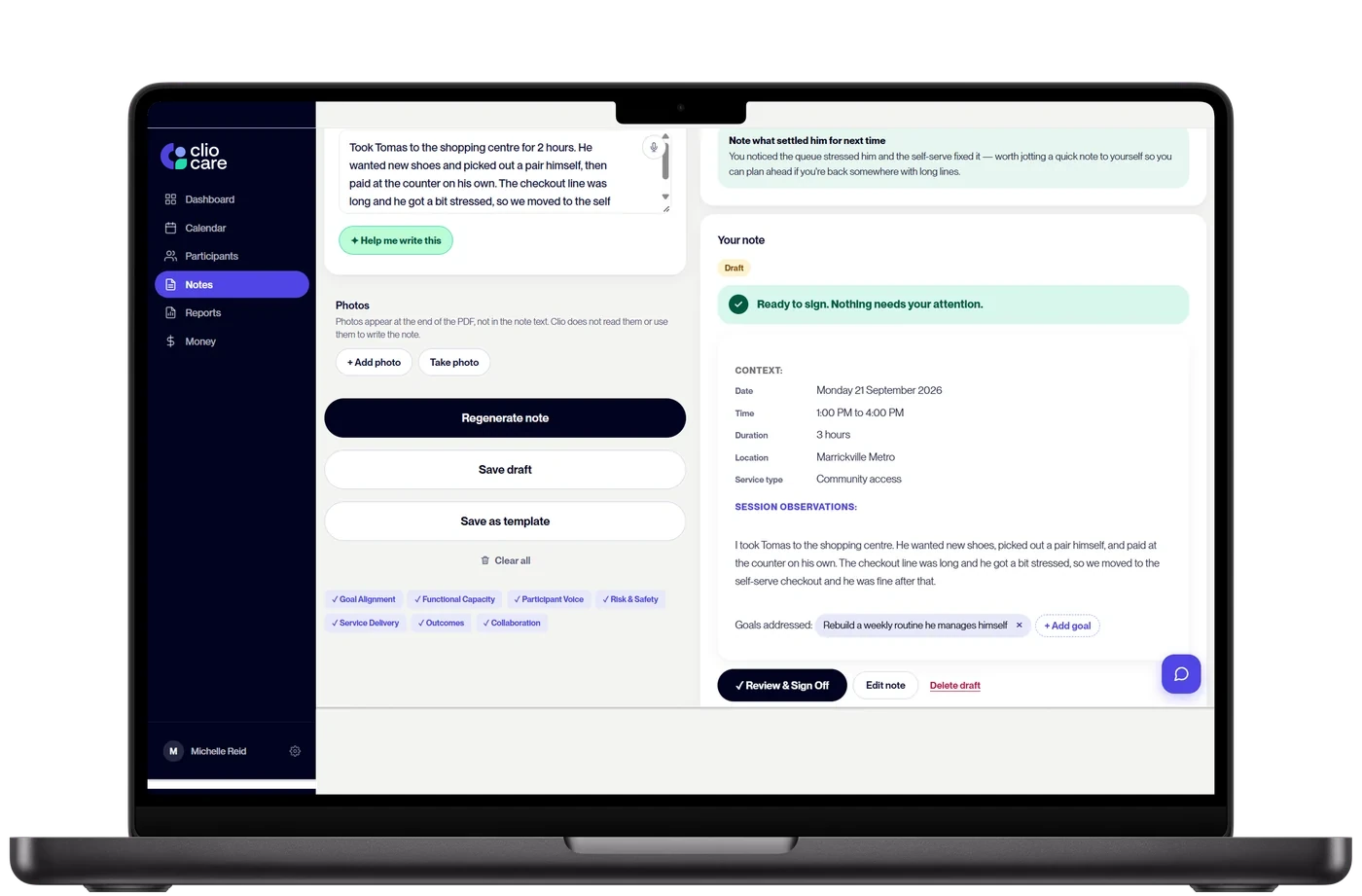
Reports built from the facts.
Months of notes, one report, in about a minute. By the time your report is due, a worker might have three, six or twelve months of notes. They pick the participant and the dates, and Clio Care reads every note they signed in that period and writes the report: each goal in turn, what happened in date order with the evidence from the notes, and where the participant is now compared with the start. The worker reads it, edits anything that needs it and signs it.
- Only what the notes say. If the notes didn't say it, the report doesn't either. It keeps the worker's own words and adds no interpretation, so it's as accurate as the notes behind it.
- Structured properly. Every goal, how often it was worked on, dated milestones from the notes as evidence, where the participant is now and how that compares with the start. Goals that weren't worked on are listed as not addressed. Then overall progress, and recommendations that follow from what was documented.
- Reviewing, not writing from scratch. The worker checks a finished draft instead of piecing months of shifts together from memory. Less of their time, and a more accurate report for you.
- Plan review, incident summary and handover too. From the same signed notes, when you need a different kind of report.
- Sent straight to you. Emailed as a PDF with the worker's name on it, saying how many signed notes it came from and the dates they cover. Your reply goes to the worker.
Built on the Note Integrity Standard.
Clio Care's notes follow a public standard. It only writes what the worker told it, it asks rather than fills when something is missing, and it keeps its original version beside the worker's edits. If any of that changes, the Standard says so, with the date.
Reports are held to the same rule. They're built only from notes written to the Standard, and they add nothing the notes didn't say. Good notes in, a report you can rely on out.
Read the Note Integrity StandardFor coordinators, answered.
Is Clio Care for support coordinators?
This page is about the independent support workers you coordinate for. Clio Care is built for them: notes, reports, invoices and their calendar in one app. If you'd like help with your own case notes and NDIA reports, see Clio Care for support coordinators.
Does Clio Care add anything the worker didn't say?
No. Clio Care writes the note only from what the worker described. If something a note needs is missing, it marks the gap in red for the worker to fill in instead of guessing, and the note can't be signed until they do.
Which reports can workers make?
Four: a goal progress report, a plan review summary, an incident summary and a handover report. Each is built from the worker's own signed notes for the participant and the dates they choose.
Who signs the report?
The worker. They review it, change anything they like and sign it off. The report says it was generated with Clio Care AI from a set number of signed case notes over the dates it covers, and that the worker reviewed and signed it.
How does the worker send me a report?
By email from Clio Care, as a PDF. It comes from an address with the worker's name on it, and when you reply, your reply goes to the worker.
What does it cost the worker?
Workers can try Clio Care free for 30 days with no card. After that it's $15 a month for 1 participant or $29 a month for unlimited participants, with every feature in both.
Know an independent worker who'd use it?
Working for themselves means no team leader, no training day and no one reading their notes before they go out. Clio Care is that support on every shift. Send them this page: it's free for workers for 30 days, with no card to start.