
Free NDIS service agreement template for support workers
An editable NDIS service agreement with everything an agreement should cover: the supports and their prices, when and how you provide them, what each of you will do, a cancellation policy that follows the current NDIS rule, how to raise a complaint, and a place for both signatures. Free, no email, yours to keep.
A4 · Word and PDF · free
Or send it from Clio and have it signed online.
No printing, scanning or chasing paper. Build the agreement in Clio, sign it, and send the participant, their nominee or guardian a secure link. They read it and sign on any phone or computer.
- Active the moment it's signed
The agreement shows as Active, and you both get an email with a link to the signed copy.
- A record of every signature
Who signed, whether as the participant, nominee or guardian, the date and time, and the IP address of the device they signed from.
- Nobody signs terms they haven't seen
Change the agreement and both signatures are cleared and the old link stops working.
- Kept with everything else
The agreement stays on the participant's profile next to their documents, notes and invoices, and your own screening check, first aid and insurance have a place too.
Use code SERVICE60 and your free trial is 60 days instead of 30. No card needed.
On your phone? Get the app, then enter SERVICE60 when you sign up.


What every NDIS service agreement should cover
A service agreement is a contract between you and the participant. The NDIA lists what a good one covers, and the template has a place for each.
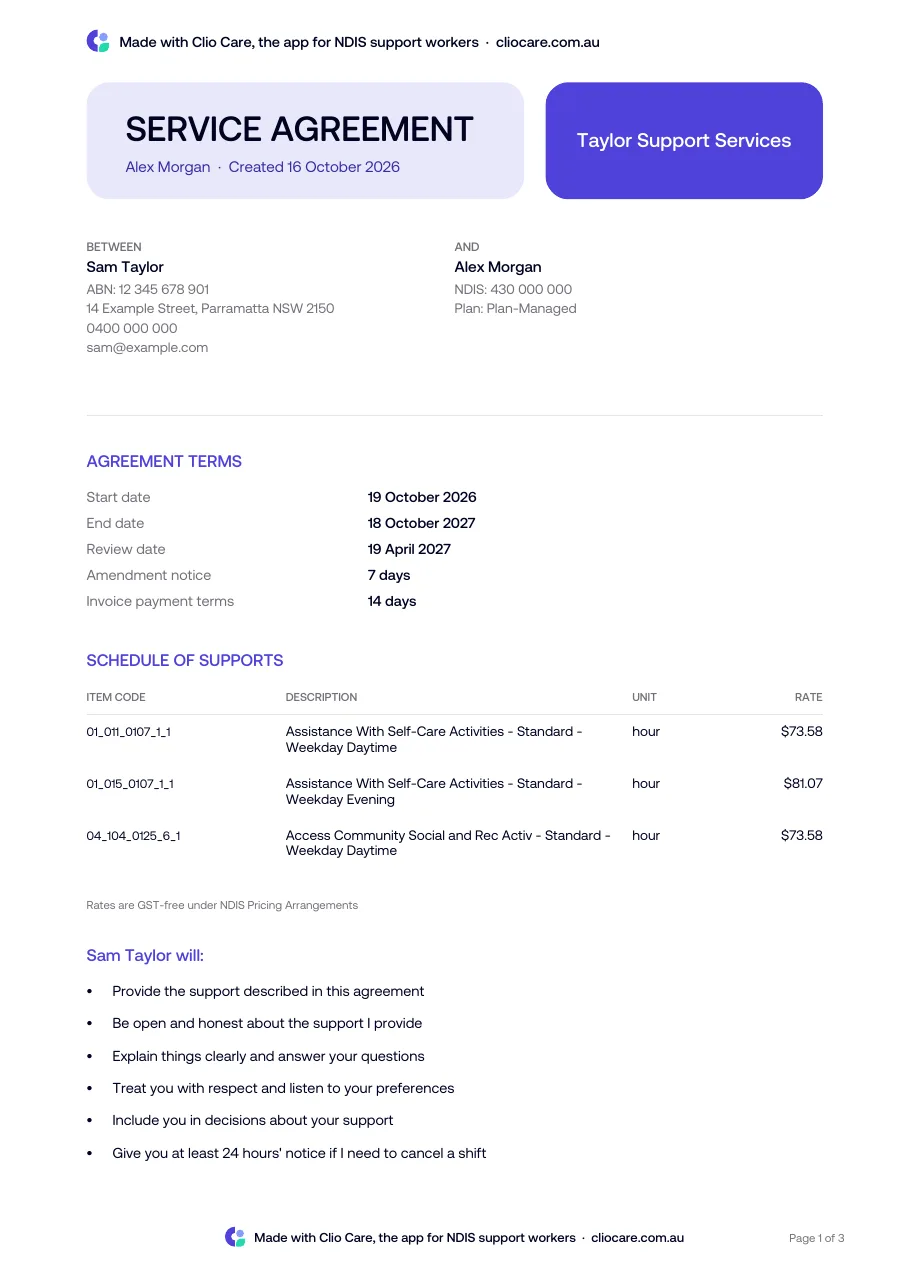
- Who it is for. You, with your ABN and contact details, and the participant, with their NDIS number and their nominee or guardian if they have one.
- The supports, and how much they cost. Each support item number, what it is, the unit and your rate, at or under the NDIS price limit.
- How and when you provide them. The days and times, where, and anything the participant wants done a certain way.
- How you get paid. Who manages the plan, who the invoices go to, and how many days they have to pay.
- Important dates. When it starts, when it ends or that it is ongoing, and when you will review it together.
- What each of you will do. Your responsibilities and the participant's, including the notice either of you gives to cancel a shift or end the agreement.
- Cancellations. When a cancellation is short notice and what you can charge for it.
- What to do if something goes wrong. How to raise a concern with you, and the NDIS Quality and Safeguards Commission if it isn't fixed.
The NDIA only requires a written agreement for Specialist Disability Accommodation, and recommends one for everything else. An agreement can't take away a participant's rights under the NDIS Code of Conduct or Australian Consumer Law.
A filled-in example
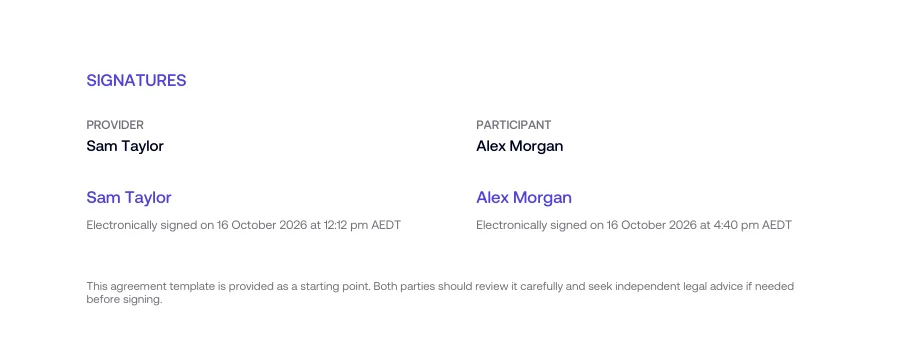
An agreement made in Clio for one plan-managed participant, with three supports at the current price limits, then signed online by both of them.
Cancellations: the clause to get right
Older templates still use the rule of 2 or 5 clear business days. This one follows the NDIS Pricing Arrangements as they stand now.
- Supports from a disability support worker. Short notice is less than 7 clear days. That covers most of what independent support workers do: personal care, community access and help at home.
- Any other support. Short notice is less than 2 clear business days.
- A no-show counts. So does the participant not being where you agreed when you arrive.
- Up to 100% of the agreed fee, but only if your service agreement sets out the terms, and not if you can fill the time with other paid work.
- You can always choose not to charge. Waiving a fee is up to you.
What a template can't do, and Clio can
A paper agreement gets signed once, then lives in a drawer. In Clio it is part of the participant's file, from the day you write it to the day you review it.
Written in minutes, with the right rates
Your details come from your profile and the participant's from theirs. Pick a support item and its description, unit and NDIS price limit fill in, so you start at the limit and lower it if you charge less. The responsibilities and cancellation policy are written for you, ready to edit.
Signed online, from any device
Sign your half, then send the participant, their nominee or guardian a secure link that works for 14 days. They read the whole agreement and sign. If you changed it after they opened it, Clio asks them to reload and read the new version first. Prefer paper? Sign your half and print it.
Active, recorded, and in both inboxes
The moment they sign, the agreement shows as Active and Clio records their name, who they signed as, the date and time, and the IP address. You both get an email with a link to the signed copy.
In the participant's file, not a drawer
Every agreement stays on the participant's profile with its review date, and shows as Expired once its end date passes. Their NDIS plan, reports and consent forms go in the same profile, next to your notes and invoices for them. Your own screening check, first aid certificate and insurance go in your documents.
NDIS service agreements, answered
Do independent support workers need a service agreement?
The NDIA only requires a written service agreement for Specialist Disability Accommodation. For everything else it is recommended, not required. Most independent support workers use one anyway, because it sets out the supports, prices and cancellation terms before anything goes wrong, and a short notice cancellation can only be charged when the agreement says so.
What should an NDIS service agreement include?
Who it is for, the supports you will provide, how and when you will provide them, how much they cost, how you will be paid, the start, end and review dates, what each of you is responsible for, and what to do if you disagree or something goes wrong. The template has a place for each of these.
What is the NDIS short notice cancellation rule?
Under the NDIS Pricing Arrangements, a cancellation is short notice when the participant doesn't show up, gives less than 7 clear days' notice for a support delivered by a disability support worker, or gives less than 2 clear business days' notice for any other support. You can charge up to 100% of the agreed fee, but only if your service agreement sets out the terms and you couldn't fill the time with other paid work.
Can a service agreement be signed electronically?
Yes. Electronic signatures on service agreements are valid in Australia under the Electronic Transactions Act. In Clio, the participant, their nominee or guardian signs from a secure link on any phone or computer, and Clio records their name, who they signed as, the date and time, and the IP address of the device they signed from.
Who signs the service agreement?
You sign as the provider. The participant signs, or their nominee or guardian if someone makes these decisions for them. Give the participant a copy and keep your own.
How long should a service agreement last?
As long as you both agree. Set a start date, an end date or ongoing, and a review date. A common choice is to match the participant's NDIS plan and review the agreement when the plan changes or their support needs change.
Is this template free?
Yes. The Word and PDF versions are free to download, edit and use, with no email and no sign-up. It is a starting point: read it carefully with the participant, change it to fit your supports, and get independent legal advice if you need it.
More free templates: NDIS invoice template, NDIS consent forms and NDIS progress notes template. Setting up on your own? Read how to become an independent NDIS support worker.
Your next agreement, signed online.
The template is yours to keep. When you're ready, Clio writes the agreement with the right rates, gets it signed from any device, and keeps it with everything else for that participant.
Code SERVICE60. No credit card.